By John Mansel-Pleydell
A recent Forbes article highlights a growing crisis in higher education: ten major college degrees—including Business, Marketing, and Accounting—are becoming redundant as AI automates entry-level white-collar roles. As universities struggle to keep their curricula relevant, many graduates are finding that their four-year investments prepared them for jobs that AI can now do in seconds.
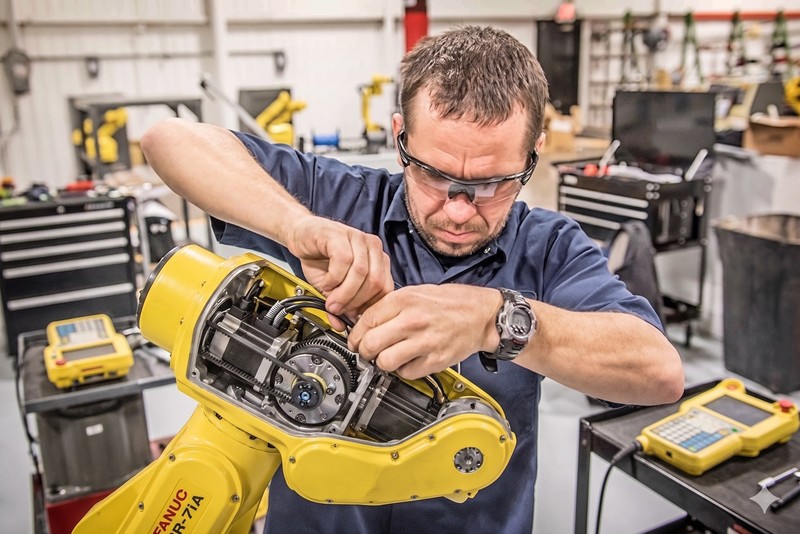
However, there is a significant exception to this trend. While AI can "vibe code" or write a legal summary, it cannot wire a facility, calibrate a precision robotic arm, or troubleshoot a complex CNC failure.
The Industrial Advantage
In Advanced Manufacturing and Robotics, automation is not a threat—it is the baseline. The distinction lies in the difference between digital automation and physical agency:
Automation as a Tool: In modern manufacturing, we assume automation is part of the job. Robots handle repetitive assembly, but they require skilled humans to program, integrate, and maintain them.
The "Moravec’s Paradox": It is relatively easy to make AI exhibit adult-level intelligence on tests, but incredibly difficult to give it the perception and mobility of a human. A computer can beat a grandmaster at chess, but it still cannot replace a maintenance technician.
High-Stakes Problem Solving: Industrial roles focus on spatial reasoning and tactile problem-solving—skills that AI currently lacks the physical "body" to perform.

The Rent-a-Human Paradox: We are entering a strange era where "Rent-a-Human" services are becoming a legitimate market. We now see autonomous AI agents—advanced software that can think and strategize—literally hiring humans to be their "hands" in the physical world. AI has realized it cannot "touch grass," sign a physical document, or troubleshoot a jammed gear. In Advanced Manufacturing, you aren't just a worker; you are the "premium human element" that technology is now forced to rent.
NW Ohio: Facilitating the Future
This shift toward specialized physical skillsets isn’t just a theory; it’s the mission of the Advanced Manufacturing Consortium (AMC). We aren't just watching the landscape change; we are facilitating the pathways that keep our students ahead of the curve.
The AMC acts as the bridge between education and industry for over 500 students in our member schools through:
Pre-Apprenticeship Facilitation: We connect students to real-world environments where they gain the foundational "human-led" skills that AI cannot replicate.
Robotics Competitions: We build capacity and excitement by challenging students to solve physical engineering problems under pressure.
Manufacturing Day Events: We highlight the high-tech, high-cleanliness, and high-paying reality of the modern skilled trades to the next generation of innovators.
The Path Forward
The Forbes piece suggests that to stay competitive, workers must move from being "generalists" to "specialists." There is no greater specialism than the intersection of human judgment and advanced machinery.
For students in NW Ohio, the message is clear: Look toward the physical world. By participating in AMC-facilitated programs, you aren't competing with AI; you are learning to lead the industry that AI is trying to "rent" its way into.
Bottom Line: While AI rewrites the career landscape for office roles, the demand for skilled hands and technical minds in NW Ohio remains unshakable. The future belongs to those who build it.
About the Author: John Mansel-Pleydell is the supervisor of the Professional Learning Group a division of the Northern Buckeye Education Council and serves as K-12 Liasion for the Advanced Manufacturing Consortium (AMC)
Disclaimer: The perspectives and industry insights shared in this article are authored by John Mansel-Pleydell based on local expertise in NW Ohio’s manufacturing landscape. This piece was developed in collaboration with Gemini, an AI by Google, to synthesize current tech trends with local educational initiatives.